Let \({\vec v}_1 = (-4,1)\text{,}\)\({\vec v}_2 = (2,2)\text{,}\)\({\vec v}_3 = (1,2,3)\text{,}\)\({\vec v}_4 = (-2,1,0)\text{.}\) Find the values of the following expressions:
Are any of these vectors perpendicular to each other?
2.
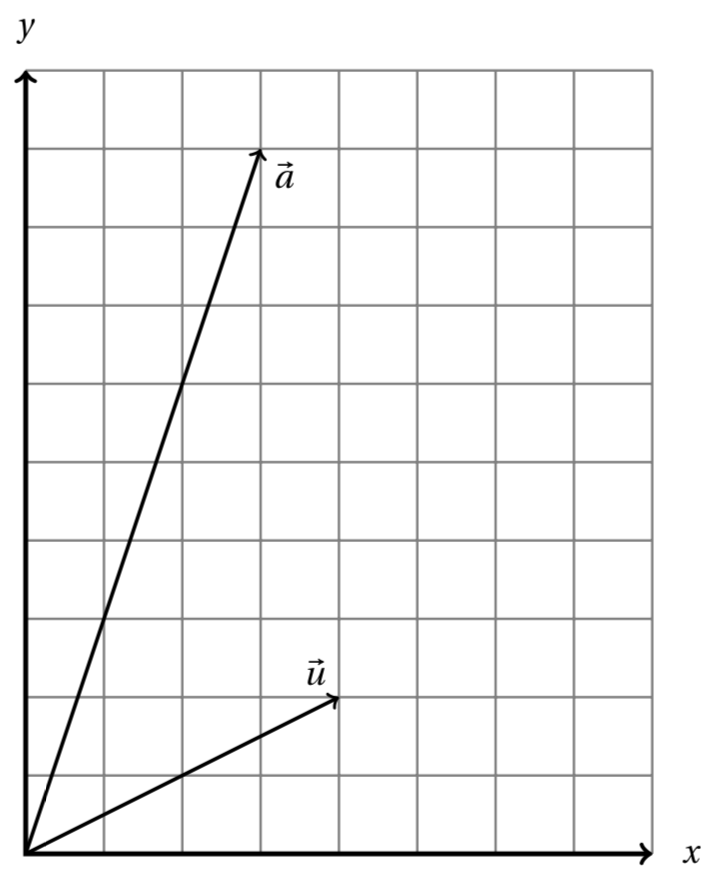
The vectors \(\vec a = (3,9)\) and \(\vec u = (4,2)\) are pictured below. Derive the formula for projection on a line and use it to find the projection of \(\vec a\) on the line spanned by \(\vec u\text{.}\) Also compute the length of the residual vector.
3.
Consider the vector equation
\begin{equation*}
m \begin{bmatrix}2 \\ 5\end{bmatrix} = \begin{bmatrix}3 \\ 7\end{bmatrix}\text{.}
\end{equation*}
(a)
Check that there is no solution \(m\) that makes the equation true.
(b)
Use projection to find the best approximation \(\hat m\text{.}\)
(c)
Compute \(\hat m \begin{bmatrix}2 \\ 5\end{bmatrix} \text{.}\)
(d)
Compute the residual vector.
(e)
Compute the length of the residual vector and explain what it means.