Section 37 Worksheets

This is a section full of worksheets. Each is a division of its own, via the <worksheet> element. This is an optional <introduction> to the current <section>. In practice you might want to rip out all the worksheets of an entire book and bundle them up as an β€œactivity book.”
If you make PDF output you will notice an increased amount of control over layout. Also, if the publication file elects draft mode, then there will be visual indicators of prescribed whitespace.

Worksheet 37.1 A Geometric Prelude (without authored pages)

This two-page worksheet was generously donated to the sample article by Dave Rosoff at a CuratedCourses workshop in AugustΒ 2018. It has the default (skinny) margins.
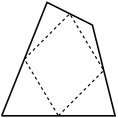
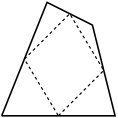
It was known to Euclid, and probably earlier, that the midpoints of the sides of any quadrilateral all lie in the same plane (even if the vertices of the quadrilateral do not). In fact, these midpoints are the vertices of a parallelogram, as pictured in FigureΒ 37.1.
Figure 37.1. The midpoints of the sides of a quadrilateral are the vertices of a parallelogram.
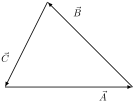
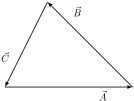
Figure 37.2. The sides of a triangle presented as vectors.
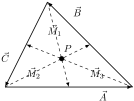
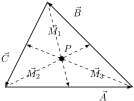
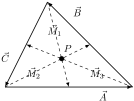
Figure 37.3. The medians of the triangle are \(\vec{M}_1\text{,}\) \(\vec{M}_2\text{,}\) and \(\vec{M}_3\text{.}\)
In this exercise, we’ll use vectors to show that the medians of any triangle (FigureΒ 37.2) intersect at a point. Recall that medians are the lines connecting the vertices of the triangle to the midpoints of their opposite edges, as in the figure. We’ll do this in a few steps.

1.

What is the value of \(\vec{A} + \vec{B} + \vec{C}\text{?}\)
FigureΒ 37.3 from the previous page is reproduced for your convenience.
described in detail following the image
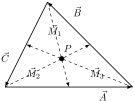
The medians of the triangle are \(\vec{M}_1\text{,}\) \(\vec{M}_2\text{,}\) and \(\vec{M}_3\text{.}\) This image description should show up in the regular view, but disappear when printing.
Figure 37.4. The medians of the triangle are \(\vec{M}_1\text{,}\) \(\vec{M}_2\text{,}\) and \(\vec{M}_3\text{.}\)

3.

To show that the point \(P\) exists (as the common intersection of the \(\vec{M}_{i}\)), show that
\begin{equation*} \vec{A} + \frac{2}{3} \vec{M}_{3} = \frac{2}{3} \vec{M}_{2} = \fillinmath{\frac{2}{3} \vec{M}_{1}-\vec{C}}\text{.} \end{equation*}

4.

If you have time, try to devise a vector proof of Euclid’s result presented at the beginning of the workshop. Recall that a parallelogram is a four-sided polygon whose opposite sides are parallel.

Wrap-up.

It’s possible to do interesting things with vector arithmetic in a coordinate-free way: we didn’t specify an origin, or any entries of any vectors in the examples.

Worksheet 37.2 A Geometric Prelude (with authored pages)

This two-page worksheet was generously donated to the sample article by Dave Rosoff at a CuratedCourses workshop in AugustΒ 2018. It has the default (skinny) margins.
It was known to Euclid, and probably earlier, that the midpoints of the sides of any quadrilateral all lie in the same plane (even if the vertices of the quadrilateral do not). In fact, these midpoints are the vertices of a parallelogram, as pictured in FigureΒ 37.1.
Figure 37.5. The midpoints of the sides of a quadrilateral are the vertices of a parallelogram.
Figure 37.6. The sides of a triangle presented as vectors.
Figure 37.7. The medians of the triangle are \(\vec{M}_1\text{,}\) \(\vec{M}_2\text{,}\) and \(\vec{M}_3\text{.}\)
In this exercise, we’ll use vectors to show that the medians of any triangle (FigureΒ 37.2) intersect at a point. Recall that medians are the lines connecting the vertices of the triangle to the midpoints of their opposite edges, as in the figure. We’ll do this in a few steps.

1.

What is the value of \(\vec{A} + \vec{B} + \vec{C}\text{?}\)
FigureΒ 37.3 from the previous page is reproduced for your convenience.
Figure 37.8. The medians of the triangle are \(\vec{M}_1\text{,}\) \(\vec{M}_2\text{,}\) and \(\vec{M}_3\text{.}\)

3.

To show that the point \(P\) exists (as the common intersection of the \(\vec{M}_{i}\)), show that
\begin{equation*} \vec{A} + \frac{2}{3} \vec{M}_{3} = \frac{2}{3} \vec{M}_{2} = \fillinmath{\frac{2}{3} \vec{M}_{1}-\vec{C}}\text{.} \end{equation*}

4.

If you have time, try to devise a vector proof of Euclid’s result presented at the beginning of the workshop. Recall that a parallelogram is a four-sided polygon whose opposite sides are parallel.

Wrap-up.

It’s possible to do interesting things with vector arithmetic in a coordinate-free way: we didn’t specify an origin, or any entries of any vectors in the examples.

Worksheet 37.3 Networks Worksheet (no authored pages)

Basic laws for electrical circuits.

This two-page worksheet was generously donated to the sample article by Virgil Pierce at a CuratedCourses workshop in AugustΒ 2018. It has default (skinny) left and right margins, but we have specified longer top and bottom margins, with the top being the larger of the two.

Example 37.11 Kirchoff’s Current Law.

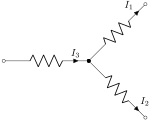
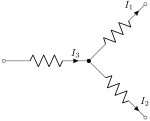
For the circuit below \(I_1 + I_2 = I_3 \text{.}\)
Kirchoffs Current Law and Kirkoffs Voltage Law combined with Ohms Law gives for any circuit of resistors and sources a linear system that may (or may not) determine the currents.

1.

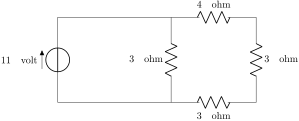
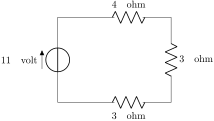
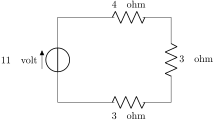
For the simple network pictured, calculuate the amperage in each part of the network by setting up a system of linear equations for the amperages.

2.

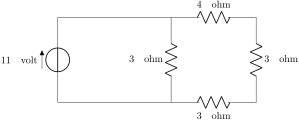
Compare it with a parallel circuit network. Calculate the amperage in each part of the network by setting up a system of linear equations for the amperages.

3.

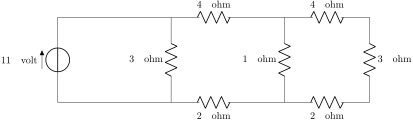
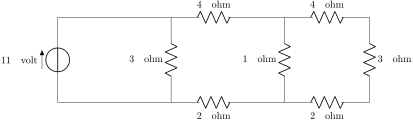
Now for a more complicated network. Calculate the amperage in each part of the network by setting up a system of linear equations for the amperages.

4.

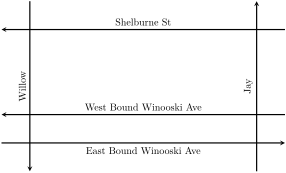
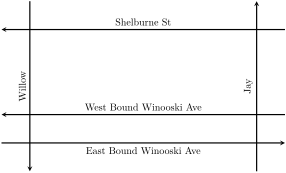
Now generalize these ideas to a context outside of electrical circuits. Consider the network of streets given in the diagram (with one-way directions as indicated).
A traffic engineer counts the hourly flow of cars into and out of this network at the entrances. They get (EB = East Bound; WB = West Bound):
Table 37.13. Estimated hourly traffic flow for the road network
EB Winooski WB Winooski Shelburne St Willow Jay
into 50 400 0 10 50
out of 55 390 20 15 30
Use a variable for each segment inside of the network and set up a system of linear equations restricting the flow. Solve the system. Note that you should not get a unique solution as traffic should be able to flow through the network in various ways.

Worksheet 37.4 Networks Worksheet (with authored pages)

Basic laws for electrical circuits.

This two-page worksheet was generously donated to the sample article by Virgil Pierce at a CuratedCourses workshop in AugustΒ 2018. It has default (skinny) left and right margins, but we have specified longer top and bottom margins, with the top being the larger of the two.

Example 37.16 Kirchoff’s Current Law.

For the circuit below \(I_1 + I_2 = I_3 \text{.}\)
Kirchoffs Current Law and Kirkoffs Voltage Law combined with Ohms Law gives for any circuit of resistors and sources a linear system that may (or may not) determine the currents.

1.

For the simple network pictured, calculuate the amperage in each part of the network by setting up a system of linear equations for the amperages.

2.

Compare it with a parallel circuit network. Calculate the amperage in each part of the network by setting up a system of linear equations for the amperages.

3.

Now for a more complicated network. Calculate the amperage in each part of the network by setting up a system of linear equations for the amperages.

4.

Now generalize these ideas to a context outside of electrical circuits. Consider the network of streets given in the diagram (with one-way directions as indicated).
A traffic engineer counts the hourly flow of cars into and out of this network at the entrances. They get (EB = East Bound; WB = West Bound):
Table 37.18. Estimated hourly traffic flow for the road network
EB Winooski WB Winooski Shelburne St Willow Jay
into 50 400 0 10 50
out of 55 390 20 15 30
Use a variable for each segment inside of the network and set up a system of linear equations restricting the flow. Solve the system. Note that you should not get a unique solution as traffic should be able to flow through the network in various ways.

Worksheet 37.5 Worksheet

This is a mock one-page worksheet for testing purposes. We have specified an overall margin just slightly less than the default.

1.

This <exercise> is a panel of a <sidebyside>, and the image below is not a panel. So it is sized by its own @width of 50%, relative to the available width where it sits.

2.

Integer sagittis dictum turpis vel aliquet. Fusce ut suscipit dolor, nec tristique nisl. Aenean luctus, leo et ornare fermentum, nibh dui vulputate leo, nec tincidunt augue ipsum sed odio. Nunc non erat sollicitudin, iaculis eros consequat, dapibus eros.
Hint.
This is a hint. You can hide it in the print preview before printing.
Answer.
Here is an answer. Also hidable.
Solution.
This is a rather long solution. When you hide or show it in the print preview, the workspace should be adjusted (the page will reload).
Integer sagittis dictum turpis vel aliquet. Fusce ut suscipit dolor, nec tristique nisl. Aenean luctus, leo et ornare fermentum, nibh dui vulputate leo, nec tincidunt augue ipsum sed odio. Nunc non erat sollicitudin, iaculis eros consequat, dapibus eros.
A two-line paragraph interspersed to check on spacing, breaks and all that.

3. A full-width exercise.

Praesent rutrum scelerisque felis sit amet adipiscing. Phasellus in mollis velit. Nunc malesuada felis sit amet massa cursus, eget elementum neque viverra.
Integer sagittis dictum turpis vel aliquet. Fusce ut suscipit dolor, nec tristique nisl. Aenean luctus, leo et ornare fermentum, nibh dui vulputate leo, nec tincidunt augue ipsum sed odio. Nunc non erat sollicitudin, iaculis eros consequat, dapibus eros.
Solution.
This is a sample solution for a full-width exercise. Integer sagittis dictum turpis vel aliquet. Fusce ut suscipit dolor, nec tristique nisl. Aenean luctus, leo et ornare fermentum, nibh dui vulputate leo, nec tincidunt augue ipsum sed odio. Nunc non erat sollicitudin, iaculis eros consequat, dapibus eros.
Another two-line paragraph interspersed to check on spacing, breaks and all that.

4.

Praesent rutrum scelerisque felis sit amet adipiscing. Phasellus in mollis velit. Nunc malesuada felis sit amet massa cursus, eget elementum neque viverra.

5.

Integer sagittis dictum turpis vel aliquet. Fusce ut suscipit dolor, nec tristique nisl. Aenean luctus, leo et ornare fermentum, nibh dui vulputate leo, nec tincidunt augue ipsum sed odio. Nunc non erat sollicitudin, iaculis eros consequat, dapibus eros.

6.

Praesent rutrum scelerisque felis sit amet adipiscing. Phasellus in mollis velit. Nunc malesuada felis sit amet massa cursus, eget elementum neque viverra.

Activity 37.1 A Mock Activity.

The problem, as we see it.
Hint.
A worksheet could have hints, no? But no spacing. Note row below has widths set to balance the heights.

7.

Praesent rutrum scelerisque felis sit amet adipiscing. Phasellus in mollis velit. Nunc malesuada felis sit amet massa cursus, eget elementum neque viverra.

8.

Integer sagittis dictum turpis vel aliquet. Fusce ut suscipit dolor, nec tristique nisl. Aenean luctus, leo et ornare fermentum, nibh dui vulputate leo, nec tincidunt augue ipsum sed odio. Nunc non erat sollicitudin, iaculis eros consequat, dapibus eros.

9.

Praesent rutrum scelerisque felis sit amet adipiscing. Phasellus in mollis velit. Nunc malesuada felis sit amet massa cursus, eget elementum neque viverra.

Worksheet 37.6 Dot products and projection

1.

Let \({\vec v}_1 = (-4,1)\text{,}\) \({\vec v}_2 = (2,2)\text{,}\) \({\vec v}_3 = (1,2,3)\text{,}\) \({\vec v}_4 = (-2,1,0)\text{.}\) Find the values of the following expressions:

2.

The vectors \(\vec a = (3,9)\) and \(\vec b = (4,2)\) are pictured below. Derive the formula for projection on a line and use it to find the projection of \(\vec a\) on the line spanned by \(\vec u\text{.}\) Also compute the length of the residual vector.
 1 
Here is a footnote.
Figure 37.19. Two vectors \(\vec a\) and \(\vec b\text{.}\)
Diagram Exploration Keyboard Controls
Key Action
Enter, A Activate keyboard driven exploration
B Activate menu driven exploration
Escape Leave exploration mode
Cursor down Explore next lower level
Cursor up Explore next upper level
Cursor right Explore next element on level
Cursor left Explore previous element on level
X Toggle expert mode
W Extra details if available
Space Repeat speech
M Activate step magnification
Comma Activate direct magnification
N Deactivate magnification
Z Toggle subtitles
C Cycle contrast settings
T Monochrome colours
L Toggle language (if available)
K Kill current sound
Y Stop sound output
O Start and stop sonification
P Repeat sonification output

3.

Consider the vector equation
\begin{equation*} m \begin{bmatrix}2 \\ 5\end{bmatrix} = \begin{bmatrix}3 \\ 7\end{bmatrix}\text{.} \end{equation*}

(a)

Check that there is no solution \(m\) that makes the equation true.

(b)

Use projection to find the best approximation \(\hat m\text{.}\)

(c)

Compute \(\hat m \begin{bmatrix}2 \\ 5\end{bmatrix} \text{.}\)

(e)

Compute the length of the residual vector and explain what it means.

Worksheet 37.7 Worksheet

Worksheet 37.8 Worksheet

Worksheet 37.9 Worksheet

This is a mock worksheet for testing the use of @workspace on an <exercise> in a worksheet.
Do things to the following.
Now, do things to the following, again.

Worksheet 37.10 Blocks Taller Than a Page

This is a mock worksheet for testing the print preview when a single block is taller than a page. Such a block is cut between the paragraphs, displays, and list items it holds, and the pieces go onto as many pages as they need. Nothing here should run off the foot of a page, with the hints, answers, and solutions shown or hidden.

1.

Show that the sum of the first \(n\) odd positive integers is \(n^2\text{.}\) The solution is far longer than it needs to be.
Hint.
Induction.
Solution.
We argue by induction on \(n\text{,}\) after a great deal of preparation. Write \(S(n)\) for the sum, so that
\begin{equation*} S(n)=\sum_{k=1}^{n}(2k-1)=1+3+5+\cdots+(2n-1) \end{equation*}
and the claim is that \(S(n)=n^2\text{.}\)
Paragraph 1 of 9 in this solution. The page breaks of a printout fall between rows, and a row is ordinarily a whole block. A block taller than the page has nowhere to break, so it is cut between the blocks it holds. Look for a page break that falls before or after this paragraph, and never through it.
Paragraph 2 of 9 in this solution. A block taller than the page has nowhere to break, so it is cut between the blocks it holds. Each piece after the first is a row of its own, and may open a page. Look for a page break that falls before or after this paragraph, and never through it.
Paragraph 3 of 9 in this solution. Each piece after the first is a row of its own, and may open a page. The space between two pieces should be the space the two blocks had before the cut. Look for a page break that falls before or after this paragraph, and never through it.

Paragraph 4 of 9 in this solution. The space between two pieces should be the space the two blocks had before the cut. A heading stays with the block that follows it, so it never closes a page. Look for a page break that falls before or after this paragraph, and never through it.
Paragraph 5 of 9 in this solution. A heading stays with the block that follows it, so it never closes a page. Reveal and hide the hints, answers, and solutions, and the pieces come and go together. Look for a page break that falls before or after this paragraph, and never through it.
Paragraph 6 of 9 in this solution. Reveal and hide the hints, answers, and solutions, and the pieces come and go together. The page breaks of a printout fall between rows, and a row is ordinarily a whole block. Look for a page break that falls before or after this paragraph, and never through it.
Paragraph 7 of 9 in this solution. The page breaks of a printout fall between rows, and a row is ordinarily a whole block. A block taller than the page has nowhere to break, so it is cut between the blocks it holds. Look for a page break that falls before or after this paragraph, and never through it.
Paragraph 8 of 9 in this solution. A block taller than the page has nowhere to break, so it is cut between the blocks it holds. Each piece after the first is a row of its own, and may open a page. Look for a page break that falls before or after this paragraph, and never through it.
Paragraph 9 of 9 in this solution. Each piece after the first is a row of its own, and may open a page. The space between two pieces should be the space the two blocks had before the cut. Look for a page break that falls before or after this paragraph, and never through it.
The first cases can be checked by hand.
  1. \(S(1)=1=1^2\text{.}\)
  2. \(S(2)=1+3=4=2^2\text{.}\)
  3. \(S(3)=1+3+5=9=3^2\text{.}\)
  4. \(S(4)=1+3+5+7=16=4^2\text{.}\)
  5. \(S(5)=1+3+5+7+9=25=5^2\text{.}\)
  6. \(S(6)=1+3+5+7+9+11=36=6^2\text{.}\)
Now suppose \(S(n)=n^2\text{.}\) Then
\begin{equation*} S(n+1)=S(n)+\bigl(2(n+1)-1\bigr)=n^2+2n+1=(n+1)^2 \end{equation*}
which is the claim for \(n+1\text{.}\)
Paragraph 1 of 9 in this solution. The page breaks of a printout fall between rows, and a row is ordinarily a whole block. A block taller than the page has nowhere to break, so it is cut between the blocks it holds. Look for a page break that falls before or after this paragraph, and never through it.
Paragraph 2 of 9 in this solution. A block taller than the page has nowhere to break, so it is cut between the blocks it holds. Each piece after the first is a row of its own, and may open a page. Look for a page break that falls before or after this paragraph, and never through it.
Paragraph 3 of 9 in this solution. Each piece after the first is a row of its own, and may open a page. The space between two pieces should be the space the two blocks had before the cut. Look for a page break that falls before or after this paragraph, and never through it.
Paragraph 4 of 9 in this solution. The space between two pieces should be the space the two blocks had before the cut. A heading stays with the block that follows it, so it never closes a page. Look for a page break that falls before or after this paragraph, and never through it.
Paragraph 5 of 9 in this solution. A heading stays with the block that follows it, so it never closes a page. Reveal and hide the hints, answers, and solutions, and the pieces come and go together. Look for a page break that falls before or after this paragraph, and never through it.
Paragraph 6 of 9 in this solution. Reveal and hide the hints, answers, and solutions, and the pieces come and go together. The page breaks of a printout fall between rows, and a row is ordinarily a whole block. Look for a page break that falls before or after this paragraph, and never through it.
Paragraph 7 of 9 in this solution. The page breaks of a printout fall between rows, and a row is ordinarily a whole block. A block taller than the page has nowhere to break, so it is cut between the blocks it holds. Look for a page break that falls before or after this paragraph, and never through it.
Paragraph 8 of 9 in this solution. A block taller than the page has nowhere to break, so it is cut between the blocks it holds. Each piece after the first is a row of its own, and may open a page. Look for a page break that falls before or after this paragraph, and never through it.
Paragraph 9 of 9 in this solution. Each piece after the first is a row of its own, and may open a page. The space between two pieces should be the space the two blocks had before the cut. Look for a page break that falls before or after this paragraph, and never through it.

Remark 37.20 A Long Remark.

A block that is not a hint, answer, or solution is cut the same way when it is taller than a page. The paragraphs of this remark should be spaced on every page as they are on the first.
Paragraph 1 of 16 in this remark. The page breaks of a printout fall between rows, and a row is ordinarily a whole block. A block taller than the page has nowhere to break, so it is cut between the blocks it holds. Look for a page break that falls before or after this paragraph, and never through it.
Paragraph 2 of 16 in this remark. A block taller than the page has nowhere to break, so it is cut between the blocks it holds. Each piece after the first is a row of its own, and may open a page. Look for a page break that falls before or after this paragraph, and never through it.
Paragraph 3 of 16 in this remark. Each piece after the first is a row of its own, and may open a page. The space between two pieces should be the space the two blocks had before the cut. Look for a page break that falls before or after this paragraph, and never through it.
Paragraph 4 of 16 in this remark. The space between two pieces should be the space the two blocks had before the cut. A heading stays with the block that follows it, so it never closes a page. Look for a page break that falls before or after this paragraph, and never through it.
Paragraph 5 of 16 in this remark. A heading stays with the block that follows it, so it never closes a page. Reveal and hide the hints, answers, and solutions, and the pieces come and go together. Look for a page break that falls before or after this paragraph, and never through it.
Paragraph 6 of 16 in this remark. Reveal and hide the hints, answers, and solutions, and the pieces come and go together. The page breaks of a printout fall between rows, and a row is ordinarily a whole block. Look for a page break that falls before or after this paragraph, and never through it.
Paragraph 7 of 16 in this remark. The page breaks of a printout fall between rows, and a row is ordinarily a whole block. A block taller than the page has nowhere to break, so it is cut between the blocks it holds. Look for a page break that falls before or after this paragraph, and never through it.
Paragraph 8 of 16 in this remark. A block taller than the page has nowhere to break, so it is cut between the blocks it holds. Each piece after the first is a row of its own, and may open a page. Look for a page break that falls before or after this paragraph, and never through it.
Paragraph 9 of 16 in this remark. Each piece after the first is a row of its own, and may open a page. The space between two pieces should be the space the two blocks had before the cut. Look for a page break that falls before or after this paragraph, and never through it.
Paragraph 10 of 16 in this remark. The space between two pieces should be the space the two blocks had before the cut. A heading stays with the block that follows it, so it never closes a page. Look for a page break that falls before or after this paragraph, and never through it.
Paragraph 11 of 16 in this remark. A heading stays with the block that follows it, so it never closes a page. Reveal and hide the hints, answers, and solutions, and the pieces come and go together. Look for a page break that falls before or after this paragraph, and never through it.
Paragraph 12 of 16 in this remark. Reveal and hide the hints, answers, and solutions, and the pieces come and go together. The page breaks of a printout fall between rows, and a row is ordinarily a whole block. Look for a page break that falls before or after this paragraph, and never through it.
Paragraph 13 of 16 in this remark. The page breaks of a printout fall between rows, and a row is ordinarily a whole block. A block taller than the page has nowhere to break, so it is cut between the blocks it holds. Look for a page break that falls before or after this paragraph, and never through it.
Paragraph 14 of 16 in this remark. A block taller than the page has nowhere to break, so it is cut between the blocks it holds. Each piece after the first is a row of its own, and may open a page. Look for a page break that falls before or after this paragraph, and never through it.
Paragraph 15 of 16 in this remark. Each piece after the first is a row of its own, and may open a page. The space between two pieces should be the space the two blocks had before the cut. Look for a page break that falls before or after this paragraph, and never through it.
Paragraph 16 of 16 in this remark. The space between two pieces should be the space the two blocks had before the cut. A heading stays with the block that follows it, so it never closes a page. Look for a page break that falls before or after this paragraph, and never through it.

2.

Name the parts of a printout. The hint is a long description list, which is cut ahead of a term and never between a term and its description.
Hint.
Some terms.
Row
A block that pagination places whole. This is term 1 of 14, and its description stays on the page where the term is. A description needs a few lines of text before enough of them, one after another, are taller than a page.
Page
A sheet of paper, less its margins. This is term 2 of 14, and its description stays on the page where the term is. A description needs a few lines of text before enough of them, one after another, are taller than a page.
Workspace
Blank room left for writing. This is term 3 of 14, and its description stays on the page where the term is. A description needs a few lines of text before enough of them, one after another, are taller than a page.
Spillover
A page added for what no longer fits. This is term 4 of 14, and its description stays on the page where the term is. A description needs a few lines of text before enough of them, one after another, are taller than a page.
Header
A band across the top of a page. This is term 5 of 14, and its description stays on the page where the term is. A description needs a few lines of text before enough of them, one after another, are taller than a page.
Footer
A band across the foot of a page. This is term 6 of 14, and its description stays on the page where the term is. A description needs a few lines of text before enough of them, one after another, are taller than a page.
Footnote
A note set at the foot of the page that refers to it. This is term 7 of 14, and its description stays on the page where the term is. A description needs a few lines of text before enough of them, one after another, are taller than a page.
Hint
A nudge toward an answer. This is term 8 of 14, and its description stays on the page where the term is. A description needs a few lines of text before enough of them, one after another, are taller than a page.
Answer
A final result, without the reasoning. This is term 9 of 14, and its description stays on the page where the term is. A description needs a few lines of text before enough of them, one after another, are taller than a page.
Solution
A full account of the reasoning. This is term 10 of 14, and its description stays on the page where the term is. A description needs a few lines of text before enough of them, one after another, are taller than a page.
Margin
The room between the paper’s edge and the text. This is term 11 of 14, and its description stays on the page where the term is. A description needs a few lines of text before enough of them, one after another, are taller than a page.
Piece
A part of a block that was cut. This is term 12 of 14, and its description stays on the page where the term is. A description needs a few lines of text before enough of them, one after another, are taller than a page.
Continuation
A piece after the first. This is term 13 of 14, and its description stays on the page where the term is. A description needs a few lines of text before enough of them, one after another, are taller than a page.
Group
A question with its solutions and workspace. This is term 14 of 14, and its description stays on the page where the term is. A description needs a few lines of text before enough of them, one after another, are taller than a page.

3.

This exercise has no workspace, and it closes the worksheet with a long solution. With the solution hidden, no blank page should follow this one.
Solution.
Paragraph 1 of 18 in this solution. The page breaks of a printout fall between rows, and a row is ordinarily a whole block. A block taller than the page has nowhere to break, so it is cut between the blocks it holds. Look for a page break that falls before or after this paragraph, and never through it.
Paragraph 2 of 18 in this solution. A block taller than the page has nowhere to break, so it is cut between the blocks it holds. Each piece after the first is a row of its own, and may open a page. Look for a page break that falls before or after this paragraph, and never through it.
Paragraph 3 of 18 in this solution. Each piece after the first is a row of its own, and may open a page. The space between two pieces should be the space the two blocks had before the cut. Look for a page break that falls before or after this paragraph, and never through it.
Paragraph 4 of 18 in this solution. The space between two pieces should be the space the two blocks had before the cut. A heading stays with the block that follows it, so it never closes a page. Look for a page break that falls before or after this paragraph, and never through it.
Paragraph 5 of 18 in this solution. A heading stays with the block that follows it, so it never closes a page. Reveal and hide the hints, answers, and solutions, and the pieces come and go together. Look for a page break that falls before or after this paragraph, and never through it.
Paragraph 6 of 18 in this solution. Reveal and hide the hints, answers, and solutions, and the pieces come and go together. The page breaks of a printout fall between rows, and a row is ordinarily a whole block. Look for a page break that falls before or after this paragraph, and never through it.
Paragraph 7 of 18 in this solution. The page breaks of a printout fall between rows, and a row is ordinarily a whole block. A block taller than the page has nowhere to break, so it is cut between the blocks it holds. Look for a page break that falls before or after this paragraph, and never through it.
Paragraph 8 of 18 in this solution. A block taller than the page has nowhere to break, so it is cut between the blocks it holds. Each piece after the first is a row of its own, and may open a page. Look for a page break that falls before or after this paragraph, and never through it.
Paragraph 9 of 18 in this solution. Each piece after the first is a row of its own, and may open a page. The space between two pieces should be the space the two blocks had before the cut. Look for a page break that falls before or after this paragraph, and never through it.
Paragraph 10 of 18 in this solution. The space between two pieces should be the space the two blocks had before the cut. A heading stays with the block that follows it, so it never closes a page. Look for a page break that falls before or after this paragraph, and never through it.
Paragraph 11 of 18 in this solution. A heading stays with the block that follows it, so it never closes a page. Reveal and hide the hints, answers, and solutions, and the pieces come and go together. Look for a page break that falls before or after this paragraph, and never through it.
Paragraph 12 of 18 in this solution. Reveal and hide the hints, answers, and solutions, and the pieces come and go together. The page breaks of a printout fall between rows, and a row is ordinarily a whole block. Look for a page break that falls before or after this paragraph, and never through it.
Paragraph 13 of 18 in this solution. The page breaks of a printout fall between rows, and a row is ordinarily a whole block. A block taller than the page has nowhere to break, so it is cut between the blocks it holds. Look for a page break that falls before or after this paragraph, and never through it.
Paragraph 14 of 18 in this solution. A block taller than the page has nowhere to break, so it is cut between the blocks it holds. Each piece after the first is a row of its own, and may open a page. Look for a page break that falls before or after this paragraph, and never through it.
Paragraph 15 of 18 in this solution. Each piece after the first is a row of its own, and may open a page. The space between two pieces should be the space the two blocks had before the cut. Look for a page break that falls before or after this paragraph, and never through it.
Paragraph 16 of 18 in this solution. The space between two pieces should be the space the two blocks had before the cut. A heading stays with the block that follows it, so it never closes a page. Look for a page break that falls before or after this paragraph, and never through it.
Paragraph 17 of 18 in this solution. A heading stays with the block that follows it, so it never closes a page. Reveal and hide the hints, answers, and solutions, and the pieces come and go together. Look for a page break that falls before or after this paragraph, and never through it.
Paragraph 18 of 18 in this solution. Reveal and hide the hints, answers, and solutions, and the pieces come and go together. The page breaks of a printout fall between rows, and a row is ordinarily a whole block. Look for a page break that falls before or after this paragraph, and never through it.
Worksheet 37.11 Worksheet with an exercise with tasks and subtasks

Page breaking between tasks in a single exercise can be tricky. This is a test for that.

Worksheet 37.12 Worksheet with <paragraphs>

This is a test of the <paragraphs> element within a worksheet. It should be able to contain exercises that have workspace, and we should be able to insert page breaks even inside of paragraphs.

Warm up.

1.

This is a warm-up exercise. It should have a small workspace and be on the first page of the worksheet.

More exercises.

2.

This is a second exercise. It should have a larger workspace and be on the second page of the worksheet.

A third division.

This is a paragraph that starts the third <paragraphs> division.

4.

This is an exercise in the third paragraphs division inside a side-by-side.

5.

This is a second exercise in the third paragraphs division. It should have a larger workspace and be on the fourth page of the worksheet.

6.

This is a third exercise in the third paragraphs division. It should have a larger workspace and be on the fifth page of the worksheet.